I have a couple of posts I'm working on for this weekend, but in the meantime, Kyle recommended that I repost a comment I left at CFLF.
Anyways, the context of this is as follows: Kyle, justifiably outraged at the collective yawn that occured in the wake of the revelations that President Bush personally approved torture, sent his local (Republican) congresswoman a letter in connection with an ACLU letter-writing campaign. He was shocked when he received a response back, apparently bearing the signature of the congresswoman herself. Then he read the letter, which not surprisingly amounted to a non-responsive response. Then he fact-checked some of the claims in the letter. Somewhat surprisingly, he found that the underlying facts for the claims in the Congresswoman's letter were, uhh, inconsistent at best.
My reply to Kyle's post was as follows:
It’s been about 10 years since I was “working” on Capitol Hill, though I did some stuff on the lobbying side of things during and just after law school. But I can pretty much explain step by step what happened here to provide some context for you (in some ways, this makes this story even worse, in other ways less bad because it’s pretty standard procedure…of course, the fact that it’s standard procedure on both sides of the aisle ought to tell you something about the futility of ever achieving good governance):
1. Sometime in the two years since the watered-down Military Commissions Act passed, and almost certainly well before you sent your letter, some other constituent from your district sent a letter to the Congresswoman about the torture issue. Based on the language of the response you received, I’m guessing that the letter from the prior constituent was written in anger about Bush’s cynical signing statement to circumvent that Act, though I could well be wrong about this.
2. An intern in the Congresswoman’s office opened the prior constituent’s letter, reviewed it, and determined the Legislative Assistant (”LA”) in the office most likely to be responsible for correspondence on the torture issue.
3. This LA (most likely in his/her mid-20’s since Republicans aren’t too concerned about torture and would thus likely assign this issue to a junior LA rather than a senior LA or the Legislative Coordinator) then reviewed his/her file of form letters and determined that none of the existing form letters would even remotely apply to this constituent’s letter.
4. The LA (who was, again, almost certainly in his/her mid-20’s, with no legal background whatsoever) then tried to research the official GOP talking points on this issue; they may have also pulled the Congressional Research Services file on torture and cherry-picked, out of context, the bullet points seemingly most favorable to their boss’ position.
5. Most likely using a template for constituent correspondence where the constituent disagrees with the Congresswoman, the LA then attempted to draft a letter that was both an inoffensive-sounding non-response response to the original constituent letter and generic enough to be used as a reply to future related constituent correspondence. The LA then gave the draft to the LC and maybe the Chief of Staff for a quick once-over, and the letter was then sent out to the constituent, with a staffer signing on behalf of the Congresswoman.
6. The LA saved a copy of the “Congresswoman’s” response on the office hard-drive, probably with a file name along the lines of “Torture- Anti” (ok, maybe not that blatant) or “Presidential Position on Geneva - anti”
7. Several months, and probably over a year later, the Congresswoman’s office received your letter and step 2 was repeated, as was most of step 3.8. This time, though, the LA decided that a relevant form letter did exist as a possible response to your letter. Although the existing letter was not 100% on point to your concerns, it was deemed close enough, especially since the ABC report received so little play and was thus unlikely to generate enough constituent letters to warrant a significant redraft of the existing form letter. This is the letter you received.
This isn’t to say in anyway that the Congresswoman is off the hook for the poorly researched statement of her position on Geneva. Actually, it’s worse: it goes to show the way in which politicians (and believe me, the Dems are just as bad on this stuff) figure out their positions first, and the facts later. In this case, the Congresswoman, like many Republicans, takes the position of “my country and my President, right or wrong.” This position then becomes the position to which the staffers need to reconcile the facts.
Friday, May 2, 2008
Congressional Letters

Thursday, May 1, 2008
The Ideal Government
For a long while, I've been meaning to post about my conception of an ideal libertarian government based on my particular brand of libertarianism. The central issue with which I have been philosophically concerned has been the concept of centralization and competition between governments.
This post by Angelica at The Art of the Possible gave me the opportunity to delve into this concept a bit, although by no means completely. The conclusion I have arrived at is that a system that decentralizes almost all powers over the private sector is far preferable than one that places those powers entirely into the hands of one central government. However, it is also my contention that a strong centralized government is an absolute necessity - but almost entirely as a safeguard of individual rights against local governments. My full comment is below with some minor edits for grammar and comprehensibility:
One of the most important things - maybe even THE most important thing - about decentralization is that it creates something loosely resembling a free market of governments. Although costs of moving remain too high to make this a true free market, the costs are low enough that bad governance (e.g., excessive cronyism) results in fewer government “customers” (ie, taxpayers). (All this, by the way, is approximately what happened in many of the corrupt cities of the Northeast and old Rust Belt; a good comparison is between the area surrounding Buffalo, NY, which has suffered an exodus of mammoth proportions due to its corruption and incompetence, and the area surrounding the nearby City of Rochester, which, while not exactly avoiding suffering, has managed to stay on its feet in a way Buffalo could only dream about).
But since the costs of leaving a given town/locality remain relatively high as does the amount of goodies the local government can offer to cronies, there is a legitimate concern that people unable to pay those costs of leaving will get stuck in a cycle of competition between localities for cronies rather than for taxpayers. All of which is to say that [it is correct to assume] that decentralization can spread problems.
That said, I think there is an important caveat to these concerns. That caveat is that when problems arise from decentralization, they occur gradually over time as the rent-seeking* company bribes, blackmails, and extorts its way to ever-more concessions from ever-more localities. But when rent-seeking occurs on a centralized basis, it immediately effects all localities subject to the centralized government. So in the former case, the opposition has time to organize in order to reverse, stunt, or at least significantly slow the corrupt practices, while in the latter case, the rent-seekers are able to win on a mammoth, even national, scale in a matter of one or two legislative or administrative acts, possibly before opponents even have an opportunity to organize.
This isn’t to say decentralization is perfect, or even that there is no role for centralized powers. Local rent-seeking and corruption will obviously continue on a large, but mostly below-the-radar scale in a decentralized system. Because the rent-seeking and corruption are at a lower level unlikely to be exposed on a politically significant level, it is far easier to get away with corruption (and other invidious government actions) on that lower level.
Luckily, there is a ready and obvious fix to significantly mitigate these problems, which would be unavailable in a fully centralized system (in which there is no higher authority than the authority making all the decisions). That fix is to make oversight of local governments one of -if not the - primary power of the central government. In essence, the fix is to apply the broadest possible reading of the 14th Amendment as a means for the federal government to intervene to stop clearly invidious local government actions. This would mean overturning the Slaughterhouse cases and reviving Lochner, but as a libertarian, this requirement is a feature rather than a flaw. A nearly-ideal conception of government from my perspective is one in which the centralized government’s primary responsibility beyond national defense is to ensure that subsidiary governments are respecting the rights of their citizens.
Saturday, April 26, 2008
Expression and Commerce, Ct'd
A few weeks ago, I talked about a case in New Mexico where a so-called Human Rights Commission levied a punishment against a bigoted commercial artist (aka a "photographer") for refusing to make a gay couple the subject of her work. I discussed how this case was a profound example of the problem with the Supreme Court's precedent allowing restrictions on supposedly "commercial" speech.
Today, thanks to Kip, I learned of another case that shows the problem of drawing the arbitrary line between "free expression" and "commercial speech" (and thus helping to prove the long-standing libertarian point that economic regulation must inevitably result in restriction of more widely-understood personal freedoms). It seems that a microbrewer based in the town of Weed, California has been placing bottle caps on his legalized psychoactive substance products (aka "beer") that contain the statement "Try Legal Weed."
It seems that in doing so, the microbrewer has run afoul of some taxpayer funded entity known as the Alcohol and Tobacco Tax and Trade Bureau. This obscure federal agency apparently banned "[d]rug references on alcoholic beverages ... in 1994." As a result, the agency has ordered this small business to stop selling its beers with the "Try Legal Weed" caps.
The brewer, who just ordered another 400,000 of these bottle caps (at a cost of $10,000), is not surprisingly appealing the ruling. The grounds for his appeal are that the caps are not a drug reference, and thus are not intended to mislead customers into thinking the beer is marijuana. He points out that his situation is no different from the only slightly better known beer slogan "This Bud's for you."
While I appreciate and fully support the grounds for the brewer's appeal, in some ways it makes the situation even worse. His appeal amounts to an acknowledgement that the agency would be on firmer footing if the bottle caps actually were a drug reference. This, to me, gets the situation exactly wrong, and inadvertently amounts to providing sanction for the concept that the government has the ability to regulate political statements about illegal drugs so long as those statements occur in a "commercial" context.
Imagine if, instead of simply being a humorous reference to the town where the beer is produced, the bottle caps were instead directly advocating that customers skirt the law and actually "try legal weed." The brewer's appeal, by arguing that his bottle caps are legal because they are not actually a drug reference, implicitly suggests that this obscure agency would be on firmer ground if the bottle caps actually were a drug reference, and thus were actually making a statement about the legal status of marijuana. In so doing, the appeal implicitly (if unintentionally) accepts the notion that such clearly political speech is subject to regulation as long as someone is trying to make a profit off of it. How far is it, really, from regulating political statements on beer caps to regulating political statements on mass-manufactured t-shirts?
This is not to say that I think Congress is on the verge of passing legislation prohibiting the manufacture and distribution for profit of pro-marijuana t-shirts. But it is to say that there is legally no reason to distinguish between beer caps produced for profit and t-shirts produced for profit.
To paraphrase a legendary quote: First they came for the "shock jocks," but I was not a shock jock....then they came for the bigoted artists, but I was not a bigoted artist....then they came for the bad-pun-making brewers....
Bonus absurdity: if, as the agency claims, "drug references on alcoholic beverages" are banned, doesn't this mean that labels on alcoholic beverages can and should be prohibited from discussing their alcoholic content? Before you dismiss this as absurd, consider that this same agency has also gone after advertising that says one beer is stronger than another.
Friday, April 25, 2008
Vienna Ayn ("Ann") Thompson


Monday, April 21, 2008
Caine and Hackman in the same movie. This is my thesis man!
Yesterday, I linked to Jim Henley's introduction to The Art of the Possible blog. Today, I had the opportunity to play around a little bit at that site, and immediately started screaming the above line from Pigman in PCU. Indeed, the fact that it took me over a month to find this site, which was founded in part by Mona from Henley's Unqualified Offerings (one of my favorite sites, libertarian or otherwise), is a bit disturbing.
In any event, The Art of the Possible describes its mission thusly:
The Bush administration has been extreme enough in its authoritarianism, flagrant law breaking, and flouting of basic human rights norms to cause fractures in the old GOP coalition. There is now the possibility of new political alliances forming. Speaking broadly, it may be that many of the factions in the Democratic Party, and some of the factions that call themselves “libertarian,” collectively represent a kind of loose anti-authoritarian coalition, or rather, the possibility of one. This site aims to facilitate
conversation among those factions.
So here we have a site that attempts to "facilitate conversation" between liberals and libertarians. My regular readers will be aware that although I do not consider myself a "left-libertarian," I tend to have a stronger relationship with the left side of the blogosphere than the right side. So that's one big point for the Art of the Possible.
Then of course there is the fact that whenever possible I try to weave in themes about coalition building and Madisonian shifting coalitions. So score another big point for the Art of the Possible.
Next comes the fact that the Art of the Possible is geared towards the idea of creating something resembling a political realignment. Of course, I've written repeatedly about the possibility/likelihood of such a realignment occuring in the coming years (although it now seems that a split in the Dem Party caused by the Obama/Hillary fiasco is more likely than a split in the GOP now that the GOP has nominated the one candidate I thought could hold the coalition together). So that's three big points.
Finally, the Art of the Possible features two of my favorite bloggers around: Mona and, now, Jim Henley, both of Unqualified Offerings reknown. In other words: as far as I'm concerned, The Art of the Possible may be the World's Greatest Blog.
(Added bonus: In his follow-up, Mr. Henley throws in a totally gratuitous recommendation of this humble blog....many thanks are in order for that! He also raises a number of other points that are worthy of their own post on my part; alas, 'tis a bit late for that right now)
Sunday, April 20, 2008
Torture and "24"
John Cole has a post up in which he points to a story in The Guardian that claims "24" influenced interrogation tactics at Guantanamo Bay.
According to the article:
Beaver told me she arrived in Guantánamo in June 2002. In September that year there was a series of brainstorming meetings, some of which were led by Beaver, to gather possible new interrogation techniques. Ideas came from all over the place, she said. Discussion was wide-ranging. Beaver mentioned one source that I didn’t immediately follow up with her: “24 – Jack Bauer.”
There has been a lot of discussion over the last few months about whether "24" has had the effect of normalizing torture, much of it well warranted. However, I think there may have been some serious fact-checking problems with this particular story that suggests "24" was a resource for torture methods in September 2002. As I wrote in a comment to Cole's post:
Hey, did anyone care to look at the date where the phrase "24" was uttered as a source of ideas for torture? September 2002, which was not long after the first season of "24" ended and several months before the start of season 2.It's been a lot of years, and I have since stopped watching the show, but IIRC, torture was not a prominently used tactic in the first season, at least not by the "good guys." At most there was one torture scene perpetrated by the good guys, and I don't think it worked.That's not to justify the constant torture of suspects that occured in later seasons (which ultimately was why I stopped watching). But this story just doesn't seem to add up.
I'll admit, my memory could be wrong since the first season of "24" was now six years ago. So if someone can refresh my memory, I'd be quite satisfied. But this does seem to be a statement that ought to have been fact-checked a bit more thoroughly.
***UPDATE*** Thoreau noticed this problem as well, except he has a better memory than I do.
Saturday, April 19, 2008
Best Read of the Day
Jim Henley does some guest-blogging at the Art of the Possible with a discussion on the role of libertarians in American politics.
Money 'graph:
So maybe the moral question isn’t, what use can libertarians be to liberals, but what use can libertarians be to anybody? We are not going to bring about either a minarchist or anarcho-capitalist society anytime soon, where “soon” can be translated as ever. Truth be told, I’m not convinced that a purely minarchist society would be all that great to live in. As for anarcho-capitalism, I think even a lot of an-caps agree that it requires a long-term project of learning how to live that way as society. I think libertarians are, rather, the court jesters of politics. I mean that in a good way. We whisper to Caesar that that he is mortal. We caper about, turning ourselves blue if necessary, reminding everyone that government power is inescapably violent and inescapably self-interested. You’re probably not going to care, but we’re going to make you actively decide not to care. And sometimes, maybe you’ll care after all. As a class, we can be stupendously silly people, believing and saying the most absurd things. But our rulers are silly people too, in different and more malignant ways. And as fools, we have the freedom to say so.
(My emphasis.)
Read the whole thing. And for what it's worth, I suspect Henley is basically right about the role of libertarians. And if we're relegated to playing the role of court jester, I'm fine with that...it's a hell of a lot more fun (and more useful, at that) than playing the role of court sycophant.
A Real Dilemma for Libertarians
(H/T: Doug)
I would have to say that even the most militant libertarian would agree that this is appalling and ought not to be allowed:
In 2007, the ‘artist’ Guillermo Vargas Habacuc, took a dog from the street, tied him to a rope in an art gallery, and starved him to death. For several days, the ‘artist’ and the visitors of the exhibition have watched emotionless the shameful ‘masterpiece’ based on the dog’s agony, until eventually he died.
But this is not all… the prestigious Visual Arts Biennial of Central America decided that the ‘installation’ was actually art, so that Guillermo Vargas Habacuc has been invited to repeat his cruel action for the biennial of 2008.
This is a question that comes up from time to time in libertarian circles, and to which I have yet to see a truly satisfactory answer: are animal rights reconcilable with libertarianism in a way which permits humans to act freely? To be sure, in the above instance, all but a handful of libertarians would likely say that the "art" is inhumane and violative of the animal's natural rights such that it should be banned.
But where do we draw the line? There is, to be sure, some controversy about dog-fighting bans in libertarian circles, although I think even most libertarians are accepting of that. But how many libertarians take animal rights so far as to include bans on meat or, more realistically, just bans on "cruel" slaughter techniques? Not many - myself included.
So: where do property rights begin and animal rights end, or vice versa? It is difficult to come to the middle ground conclusion of most libertarians (myself included) using anything identifiable as "pure" libertarian logic. You can, however, come to either of the two more extreme conclusions using libertarian logic, depending on where you draw the line on beings entitled to rights.
Thoughts?
***UPDATE***Reading through the comments in Radley Balko's original post, it seems the "death" of the dog was a hoax. But the fact is that the dog was still horribly starved for a substantial period of time in order for the artist to prove a point.
In any event, you will find the comments at Balko's blog (at least the relevant ones) pretty intellectually stimulating, especially the debate involving the Liberty Papers' (and friend of PE) UCrawford.
The Impossibility of Monopoly
Much is frequently written about how horrible so-called "big box" stores are for the American economy. The argument is essentially that these big box stores, with their loss leaders, "unconscionably" low wages and benefits, and huge economies of scale, drive out small businesses and thus reduce competition in the marketplace, effectively creating a monopoly. In the end, the argument goes, consumer choice is eliminated and we are all effectively "slaves" to the big, bad corporations. This in turn, also means lower wages, fewer jobs, and a devastated middle-class (or lower-class).
Ignore for a moment the actual benefits to the economy that result from the lower prices such stores are able to charge. The reality is that as these stores grow larger and larger, and become more dominant, they become less and less able to respond to their local customers' demands. In essence, as Hayek would have been all too happy to point out, they eventually get so large as to run into the same calculation problem as exists in socialism. As a result, markets open up for smaller business to develop again, and the cycle repeats itself.
There was an article on this a few months back in Reason*, available here.
In any event, this morning I saw an example of this phenomenon while shopping for seat cushions for Vienna (Ayn?Constance?)'s rocking chair at Bed Bath and Beyond. This was the first time I had been in BB&B in about a year. If you've been following the market, you'd know that Bed Bath and Beyond now has what is effectively a monopoly in the national bed and bath furnishings/accessories market (the real estate crash essentially destroyed its one national rival, Linens N' Things). Despite this monopoly, its same-store sales have been falling rapidly.
To be sure, Wall Street thinks things will improve for the company in the next year, despite its extremely conservative estimate for 2008 profitability. But what I saw this morning left me convinced that the company has fallen for the socialist fallacy.
Now that the company has an effective monopoly, there are only two ways for it to grow its profits: it can charge a monopoly price (which has its own long-term problems for the company), or it can try to encroach on the business of another, somewhat closely related market. My experience this morning shows that they chose the latter option.
As a result, I found the BB&B chock full of products I never would have found a year or two ago in this particular store: a huge section of personal hygiene products like toothpaste and shampoo, and a huge section of china and glassware for its bridal registry. And, most bizarrely, a pocket version of Guitar Hero.
So what? You ask. After all, aren't they just diversifying their business? Well, yes....except that in this case, that diversification comes at a heavy cost. In order to create the inventory for the china, glassware, and personal hygiene products, they had to remove space for the types of things they're most known for, including, amongst other things: bedding, kitchen gadgets, and, yes, my seat cushions. So, when my wife and I went to look for seat cushions, the only colors available were neutral or extremely dark. Since we were looking for a seat cushion for a baby girl's room that will be a bright green with pink accents, these options were pretty much worthless to us. So we figured we would try to find a simple girlie-colored pillow in the kids' bedding section. Much to our chagrin, though, they no longer had any individual throw pillows available in that section. So, we turned to the adult throw pillow section; again, we struck out, as the only throw pillows were in either neutral or extremely dark colors.
Simply put: in order to expand their market, they were forced to get rid of a lot of their niche products upon which they had built their company, keeping only the most popular of those niche products. This, of course, leaves a huge hole in the marketplace for smaller businesses to fill. Meanwhile, with the introduction of (especially) the personal hygiene products and (less so) the fine china, Bed Bath & Beyond is taking on pharmacies (and grocery stores), as well as high end department stores, respectively. While Bed, Bath & Beyond might be able to compete successfully with department store in the fine china market, it most certainly will not be able to compete with pharmacies and grocery stores in the personal hygiene market. (Not to mention video game stores in the Guitar Hero market).
This means that Bed Bath & Beyond has opened the door for competition in its core market (ie, bedding, kitchen gadgets, seat cushions, etc.) while at the same time jumping into a market where it is highly unlikely to have much success (ie, personal hygiene and, uh, video games).
At least in the US market, Bed Bath & Beyond had essentially reached its maximum profit; in an attempt to increase or maintain that profit, it is taking an unnecessary risk that most marketing majors could tell you is outright idiotic. Within the next five years, I am predicting either a resurgence in small local (but high end) bedding businesses or the emergence of niche bedding internet businesses.
Had Bed Bath & Beyond chosen the other route for maximizing profits (ie, charging monopoly prices), it would have created a host of other problems for itself. By charging a monopoly price, the market would become open for challenges by lower-priced competitors (Target and Wal-Mart, for instance, not to mention entrepreneurs willing to accept a lower profit margin to fill a much-needed niche in the market).
Anyone who has been involved in running a business, especially one that requires maintaining an inventory, understands that you can't make something out of nothing. You can't grow a business without spending something, whether it be effort or money. Unfortunately, there are a lot of times when spending more effort or money is counterproductive. Often this is because the business owner made a bad decision. But the more a business grows, the number of available growth-enhancing decisions decreases, eventually reaching zero. This is why we should not fear the big-box store.
*Totally off-topic, but this month was the first issue of Reason with Matt Welch at the helm of the print edition. I'll admit that I liked the magazine under Nick Gillespie, but this month's issue was easily the best in the last year or so. As always, Radley Balko's article is fantastic, but the article on the Iraq War funding process was relevant in a way that Reason often fails to be. The article on bottom-up power generation by Brian Doherty was both uniquely informative and filled with the free-wheeling joy that I love so much about most forms of libertarianism.
***UPDATE*** I apparently erred in saying that same-store sales for BB&B are dramatically down. The numbers upon which that statement was based were actually overall sales rather than same-store sales (which are slightly down I might add). This does not affect my overall argument, though, which is simply that BB&B's need to continue growing as a business must inherently create openings for smaller niche competitors. In other words: the idea that big box stores will kill small business and create a whole host of other permanent problems ignores economic realities.
Thursday, April 17, 2008
Another Way the Extended Campaign Hurts the Dems- and Maybe the Country
(Via memeorandum)
Much has been written about how the continuing attacks of the two Democrat candidates are only serving to weaken the eventual winner (Obama...cough....cough) for the general election. As a result, the longer a certain candidate remains in the race, the more she is hurting her party.
There is, however, another sense in which the overly long race will hurt Obama's chances in the general election. That sense is the manner in which the drawn-out race has forced each of the two candidates to focus more and more on economic populism. Prior to Super Tuesday, free trade was at most a minor issue in the campaign. As the campaign drew on longer despite the rapidly decreasing odds of Sen. Clinton coming back, the two candidates were drawn into more and more states where economic populism is the order of the day for local Democrats.
In order to win votes in these areas, Obama and Clinton have both drifted increasingly far away from free trade, to the point that it seems as if Obama must be ignoring his otherwise excellent economic policy advisor Austan Goolsbee. To be sure, some of that has had to do with the need to distance himself from Goolsbee after the Canadian embassy silliness. But we would do well to remember that what caused that silliness in the first place was Obama's increasingly populist rhetoric on trade. While Sen. Clinton has likewise drifted further into economic populism, this has been less problematic since she has long had the ability to talk out of both sides of her mouth.
This continuing drift to the left will hurt Obama in the general election, as it gives McCain all sorts of sound bites to use against Obama to pigeon hole him as a far left radical. For me, at least, Obama's anti-trade rhetoric has already caused me to re-evaluate my tentative support of him. To be sure, I still think he's the least bad of the three from a libertarian point of view, but it is now exceedingly unlikely that I will vote for him in the general election. I suspect many of Obama's Republican defectors have had similar thoughts in the last few weeks and months. With McCain's well-established reputation as a moderate, Obama's best chance at winning was to fight McCain for the middle, hold on to the left, and maybe steal a few votes from the right as well. Now, however, he probably won't be able to steal many votes from the right, and his appeal to the middle will have to largely come out of his opposition to the war. His legendary unity rhetoric has lost a lot of its appeal in Obama's populism, which is an ideology that is rarely associated with unity.
Worse, from my perspective, is that the continuing push to the left will make it increasingly difficult for a President Obama to return to more of a centrist position on trade.
All of which is to say that I think the never-ending campaign that is the Democrat nomination process is hurting not only Obama's chances at winning, but is also hurting the country by limiting the policy options a President Obama could pursue (not only that, but from a libertarian perspective, the remaining policy options would be a huge step backwards).
This is not to say that I think Obama will lose the general election, necessarily - the fundamentals right now are just too heavily in favor of the Democrats. But it is to say that the likelihood of him beating McCain is dropping by the day.
Happiness and "Economic Self-Interest"
I've been following the ongoing discussion between publius at Obsidian Wings and Megan McArdle (and their respective commenters) with some interest. The question at issue is why working class whites not only vote Republican in heavy numbers but also passionately support Republican economic policies even though those economic policies would seem to be against their self-interest. As Megan points out, this question also runs in the other direction: why do so many wealthy Democrats so passionately support Democrat economic policies.
For publius, the answer is that the resentment and anger stirred up in the culture wars boils over into economic policies such that the response becomes almost reflexive. In other words: if liberals like it, it must be bad and evil. (I note that publius does not believe this works both ways; he believes, perhaps correctly, that wealthy Democrats would have too little to gain on the margins to have an incentive to support Republican economic policies). By contrast, Megan believes that the apparently irrational support of Republican economic policies may not be irrational at all, but instead arises from the importance of property rights in small communities.
To a large extent, I think publius is on the right track. His explanation fits well with the concept of "pu-pu platter partisanship" that I've argued has come to characterize so much of our politics. Under this concept, American politics have gotten so polarized as to effectively reduce the number of factions capable of winning any given debate from nearly infinite to only two: Democrats and Republicans. True independents (who remain divided into a nearly infinite number of factions) are too few in number and too divided to have any real say in final outcomes. Moreover, research has shown that partisans actually derive pleasure from rationalizing inconsistencies in their belief systems; as long as working class Republican partisans maintain social issues as their top priority, psychology suggests that they will actually derive pleasure from reconciling their belief systems with apparently inconsistent Republican economic policy.
That said, there are two important things both publius and Megan seem to have missed. Although a comment that Megan picked up on starts to get at the more important of them. The first problem is that publius begins with the assumption that Democrat economic policy is necessarily better for working class whites than Republican economic policy; this assumption may or may not be true, but it's not an answer that should just be assumed.
However, even accepting for sake of argument that Democrat economic policy in fact creates more financial wealth for middle class whites, publius misses something critically important. He (and it would seem, Megan as well) assumes that economic self-interest is synonymous with financial wealth. But if we've learned anything from economics, and especially from Tyler Cowen and books like Freakanomics, it's that money is not everything to everybody - or even most people. People often rationally value things far above or far below their actual monetary value.
For instance, if you were offered $100 dollars for piece of jewelry worth $50 that happens to be a family heirloom, would it be irrational to refuse the offer? Of course not - there is a sentimental or moral value to the heirloom that far exceeds the $50 windfall you would otherwise receive for the heirloom. But if you looked purely at the financial aspect of the equation, it would appear to be an extremely irrational decision to refuse to sell the heirloom.
Turning back to politics, economic policy does not occur in a vacuum. Whatever else it is, it cannot be separated from the individual voter's personal values. The individual voter may, for instance, be a hardcore libertarian type who would find any government assistance to him to be morally repugnant. The extra few hundred dollars a year in income will be quite insufficient to overcome those moral values and suddenly support the Democrat economic policy.
Similarly, it is important to note that there has always been a sense of rugged individualism in much of the United States, even if that has not necessarily translated into support for libertarianism. That sense of individualism creates an attitude in a good number of people that unwanted help from the government will in fact inhibit their sense of self-worth and accomplishment.
It's important to realize that for many Americans (myself included to a large extent- or so I like to think), their economic self-interest and financial self-interest align only insofar as they are financially secure enough to have a roof over their head and food in their belly. After that, their economic self-interest places far more value on things like family, religion, leisure (e.g., hunting) or whatever else makes them truly happy and satisfied. For many people, knowing that everything you have is something you have actually achieved on your own is priceless in and of itself*; suddenly having the government artificially bump up your wage or give you an extra tax credit will actually cheapen that pride far more than it could ever repay.
In the end, perhaps the most frequently made false assumption we see in politics is that people value money over all else.
*To all the libertarian-haters out there, this sentence comes pretty close to defining what Ayn Rand defined as "selfishness" and why she thought selfishness was thus a virtue.
Wednesday, April 16, 2008
Glad I Missed That One...
I've been pointedly trying to stay away from the horse race the last few weeks, and except for a particularly pertinent story this afternoon, have largely succeeded in doing so. But it's clear that the Dem primary has become nothing but a descent into pointless minutiae that lack anything resembling substance.
Given that, I figured tonight's debate would just be more of the same and thus I was better off watching the American Idol results show (which I hate watching, by the way). From the initial reaction in the blogosphere, it seems my decision is vindicated. Except for Taylor Marsh, who long ago descended into self-parody. I'm guessing she wrote the positive comment Sully mentions here.
Update
Jay McDonough has a follow-up post to the discussion yesterday at his site, Newshoggers, and here about McCain's economic plan.
Money quote:
"Senator McCain is, clearly, trying to "out-Bush" President Bush. Incurring additional debt at a time when our debt interest payment is the sixth largest expenditure of the federal government is reckless and irresponsible."
Of course, he could solve this by proposing to end the Iraq War....but that's just crazy talk.
Political Research Survey
I've been asked to post a link to this survey pertaining to the 2008 primaries. The survey is for a study being conducted by NYU.
I encourage all my readers to participate if they have about 10-20 minutes.
In order to not prejudice the survey results, I have closed comments to this post.
Question
Have you ever gotten the feeling that the real divide in America isn't between left, right, and libertarian, but is instead between those who have a degree of humility about their opinions and those who prefer to reside in the fever swamps? In other words: between those who treat their political opponents like mature and responsible adults, and those who infantilize and demonize their political opponents?
To me, this is the same distinction as I discussed a few weeks ago between those who know they don't understand other people, and those who think they understand other people.
Regardless, I always find debate with the former type of person to be physically invigorating, even if I wind up having to concede defeat. Debate with the latter, however, is physically draining from start to finish, and in no case does either side actually "win." (Although the resident of the fever swamp usually will declare victory despite having demonstrated nothing beyond an ability to attack a caricature of the other person). Just a thought.
Then again, this study I found discussed at Dr. X's Free Associations would seem to answer my question in the affirmative. At a minimum it would explain why the fever swamp residents so often declare victory in their debates.
FYI
I'll be starting a new job tomorrow, which will likely result in me posting less often. I will try to continue posting at least once a day, though.
More Dishonest Hillary
I really don't want to return to the horribly overblown minutiae of the Democratic primary campaign. But since today's publicized gaffe hits particularly close to home, I figure it's worth a quick comment.
For those who are unaware, Hillary Clinton has been running ads attacking Obama for his allegedly elitist remarks about small-town Pennsylvanians. One ad offers several testimonials from Pennsylvanians purportedly offended by the remarks (although the controversy appears to have had little effect).
Today the Chicago Tribune reports that one of the "Pennsylvanians" in the ad is actually registered to vote here in New Jersey, where he has lived just about his entire life (though he was born in Allentown, PA). The man purportedly moved to Bethlehem, PA sometime since February. Prior to that, the man had lived his entire life in Somerville, NJ, which is smack in the middle of New Jersey.
Let's just say that I have a little more than a passing familiarity with Somerville. For starters, it is in fact a small, working class town. If that was all you knew about the place, you would think it would be exactly the type of place that would have been offended by Obama's remarks.
The trouble is that's where the similarities end. Somerville is far from the type of place where voters' biggest issues are "God, guns, and gays." It is a town that is probably almost 50% African-American and Latino, maybe more. The immigration issue is not something that will go very far with most of the town. Although it is a working-class town, it also sits smack in the middle of one of the wealthiest counties in the country. Moreover, it has been undergoing something of an economic revival for about the last 6 or 7 years after a decade or two of decline. The downtown area is now filled with excellent, moderately priced restaurants where 10 years ago there were vacant or run-down storefronts.
The point is this: while Somerville might be a small, working-class town, it is hardly the type of place where people would have been offended by Obama's remarks. That the Clinton campaign would use someone from such a place - which isn't even in Pennsylvania - in one of her ads is just more proof that this is a campaign built almost entirely on lies and deceit.
(More at memeorandum)
Bush Denounces, Redefines Freedom
File this one under War Is Peace.
In Bush's welcoming remarks to Pope Benedict today, he said the following:
"We need your message to reject this dictatorship of relativism and embrace a culture of justice and truth," Bush said in brief remarks welcoming Benedict to
the White House. "In a world where some see freedom as simply the right to do as they wish, we need your message that true liberty requires us to live our freedom not just for ourselves, but in a spirit of mutual support."
This concept that freedom is limited by something other than a respect for others' freedoms is one of the most evil examples of Orwellian redefinitions that exists today. To be sure, Bush is hardly the first to suggest that "freedom" is something less than an absolute. The controversy over the Mohammed cartoons showed us those who would define "free speech" as being limited to inoffensive speech. Rick Santorum has talked of how he defines liberty as including an obligation to the "common good." It is this definition to which Bush today pledged his allegience. Of course, any definition that centers on striving for the "common good" begs the question of who decides the "common good."
But the idea that liberty "requires" us to act in a certain way is nothing short of a recipe for totalitarianism and authoritarianism. Far too many thinkers, including both Orwell and Hayek, have warned that authoritarianism will come under a false concept of freedom. Now that Bush has clearly expressed his redefinition of freedom and liberty, it is quite clear why his administration has been responsible for so much evil.
We can never forget that freedom does, in fact, mean the ability to do as you wish (provided you allow others to do as they wish). Any other definition makes the word "freedom" utterly devoid of meaning.
(H/T: LewRockwell.com)
Ahh, the Tyranny of the Majority
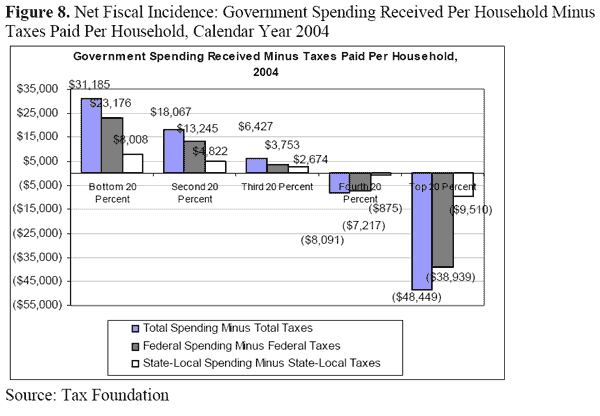
Coyote Blog has a brief discussion about the fact that 60% of people think the amount of taxes they pay is "fair."
At first blush, this would seem to be a pretty strong argument that Americans don't think they are overtaxed.
Except that Coyote Blog points out another little thing: 60% of Americans also receive more in government benefits than they pay in taxes. In other words: 60% of Americans believe that it is fair to take from the remaining 40%. This is the problem when you implement "majority rules" governance over taxation. It's awfully easy to advocate for more government programs when you don't actually have to pay into those government programs.
Tuesday, April 15, 2008
McCain and Budget Deficits
I'm going to do something interesting in this post which will piss off some of my fellow libertarians. So please hear me out.
The always-outstanding Cernig at the always-phenomenal Newshoggers site has a post that attack John McCain's economic proposal, which amounts to a plan to implement additional tax cuts and cut government spending. However, Cernig points out that McCain's spending cuts would only reduce pork barrel spending along with Medicaid and Social Security spending.
Like Cernig, I have no idea how he could cut Medicaid and Social Security, which are both non-discretionary spending. Meanwhile, despite all the (justifiable) outrage over earmarks, they make up only a minuscule fraction of the federal budget. Of course, if McCain was really serious about cutting spending, he would dramatically reduce spending on the oversold War on Terror (especially the Iraq War). As Cernig points out, we spent more on supplemental spending alone for the War on Terror last year - to little demonstrable effect - than we did on education (which is amazing in the NCLB era). The size of our defense spending is made even clearer by this graph at TaxProf Blog.
But I noticed something else in both Cernig's post and TaxProf Blog's post: one of the government's largest annual expenses is interest on the national debt. Depending on whose statistics you use, interest on the national debt is either 9% or 13.4% of federal spending. That means that about 10% of the federal budget is spent on literally nothing before another penny is spent on any program (no matter how ineffectual). Sigh. I remember the days when Republicans were deficit hawks and it was the Democrats who said that "deficits don't matter."
The thing is: that 10% of the federal budget amounts to an annual tax of its own on the American people - no one in this country gets anything out of those interest payments. Worse, of course, is the fact that it contributes to inflation, making it effectively a double tax.
My point is this: unless you believe we are currently on the left side of the Laffer Curve (which even I think is extremely doubtful), cutting taxes without unconscionable cuts in nondiscretionary spending will likely only increase our deficit. This is particularly true as we head into a clear recession.
I would argue that the best thing our next President could do to help us have lower taxes in the future is to pay down the national debt. I do not think that warrants a tax increase, by the way. It just means that we need to cut back significantly on defense spending and keep taxes at current levels. But currently, our national debt is more than our annual budget. That is not a good thing.
***UPDATE***Jay McDonough (who was the original source for a lot of these numbers) points out that the national debt is actually triple the annual budget. That is staggering on any number of levels. What makes it worse is its juxtaposition against this article from the current issue of Reason, which shows how the Bush Administration has managed to massively increase defense spending through the shady supplemental appropriations process. This process guarantees a lack of fiscal discipline while at the same time permitting the Bushies to semi-accurately make the claim that they are reducing spending (even though they're not).