

I've been asked to post a link to this survey pertaining to the 2008 primaries. The survey is for a study being conducted by NYU.
I encourage all my readers to participate if they have about 10-20 minutes.
In order to not prejudice the survey results, I have closed comments to this post.
Wednesday, April 16, 2008
Political Research Survey

Question
Have you ever gotten the feeling that the real divide in America isn't between left, right, and libertarian, but is instead between those who have a degree of humility about their opinions and those who prefer to reside in the fever swamps? In other words: between those who treat their political opponents like mature and responsible adults, and those who infantilize and demonize their political opponents?
To me, this is the same distinction as I discussed a few weeks ago between those who know they don't understand other people, and those who think they understand other people.
Regardless, I always find debate with the former type of person to be physically invigorating, even if I wind up having to concede defeat. Debate with the latter, however, is physically draining from start to finish, and in no case does either side actually "win." (Although the resident of the fever swamp usually will declare victory despite having demonstrated nothing beyond an ability to attack a caricature of the other person). Just a thought.
Then again, this study I found discussed at Dr. X's Free Associations would seem to answer my question in the affirmative. At a minimum it would explain why the fever swamp residents so often declare victory in their debates.
FYI
I'll be starting a new job tomorrow, which will likely result in me posting less often. I will try to continue posting at least once a day, though.
More Dishonest Hillary
I really don't want to return to the horribly overblown minutiae of the Democratic primary campaign. But since today's publicized gaffe hits particularly close to home, I figure it's worth a quick comment.
For those who are unaware, Hillary Clinton has been running ads attacking Obama for his allegedly elitist remarks about small-town Pennsylvanians. One ad offers several testimonials from Pennsylvanians purportedly offended by the remarks (although the controversy appears to have had little effect).
Today the Chicago Tribune reports that one of the "Pennsylvanians" in the ad is actually registered to vote here in New Jersey, where he has lived just about his entire life (though he was born in Allentown, PA). The man purportedly moved to Bethlehem, PA sometime since February. Prior to that, the man had lived his entire life in Somerville, NJ, which is smack in the middle of New Jersey.
Let's just say that I have a little more than a passing familiarity with Somerville. For starters, it is in fact a small, working class town. If that was all you knew about the place, you would think it would be exactly the type of place that would have been offended by Obama's remarks.
The trouble is that's where the similarities end. Somerville is far from the type of place where voters' biggest issues are "God, guns, and gays." It is a town that is probably almost 50% African-American and Latino, maybe more. The immigration issue is not something that will go very far with most of the town. Although it is a working-class town, it also sits smack in the middle of one of the wealthiest counties in the country. Moreover, it has been undergoing something of an economic revival for about the last 6 or 7 years after a decade or two of decline. The downtown area is now filled with excellent, moderately priced restaurants where 10 years ago there were vacant or run-down storefronts.
The point is this: while Somerville might be a small, working-class town, it is hardly the type of place where people would have been offended by Obama's remarks. That the Clinton campaign would use someone from such a place - which isn't even in Pennsylvania - in one of her ads is just more proof that this is a campaign built almost entirely on lies and deceit.
(More at memeorandum)
Bush Denounces, Redefines Freedom
File this one under War Is Peace.
In Bush's welcoming remarks to Pope Benedict today, he said the following:
"We need your message to reject this dictatorship of relativism and embrace a culture of justice and truth," Bush said in brief remarks welcoming Benedict to
the White House. "In a world where some see freedom as simply the right to do as they wish, we need your message that true liberty requires us to live our freedom not just for ourselves, but in a spirit of mutual support."
This concept that freedom is limited by something other than a respect for others' freedoms is one of the most evil examples of Orwellian redefinitions that exists today. To be sure, Bush is hardly the first to suggest that "freedom" is something less than an absolute. The controversy over the Mohammed cartoons showed us those who would define "free speech" as being limited to inoffensive speech. Rick Santorum has talked of how he defines liberty as including an obligation to the "common good." It is this definition to which Bush today pledged his allegience. Of course, any definition that centers on striving for the "common good" begs the question of who decides the "common good."
But the idea that liberty "requires" us to act in a certain way is nothing short of a recipe for totalitarianism and authoritarianism. Far too many thinkers, including both Orwell and Hayek, have warned that authoritarianism will come under a false concept of freedom. Now that Bush has clearly expressed his redefinition of freedom and liberty, it is quite clear why his administration has been responsible for so much evil.
We can never forget that freedom does, in fact, mean the ability to do as you wish (provided you allow others to do as they wish). Any other definition makes the word "freedom" utterly devoid of meaning.
(H/T: LewRockwell.com)
Ahh, the Tyranny of the Majority
Coyote Blog has a brief discussion about the fact that 60% of people think the amount of taxes they pay is "fair."
At first blush, this would seem to be a pretty strong argument that Americans don't think they are overtaxed.
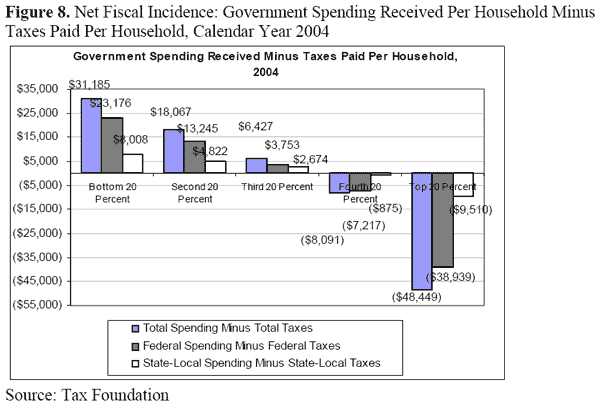
Except that Coyote Blog points out another little thing: 60% of Americans also receive more in government benefits than they pay in taxes. In other words: 60% of Americans believe that it is fair to take from the remaining 40%. This is the problem when you implement "majority rules" governance over taxation. It's awfully easy to advocate for more government programs when you don't actually have to pay into those government programs.
Tuesday, April 15, 2008
McCain and Budget Deficits
I'm going to do something interesting in this post which will piss off some of my fellow libertarians. So please hear me out.
The always-outstanding Cernig at the always-phenomenal Newshoggers site has a post that attack John McCain's economic proposal, which amounts to a plan to implement additional tax cuts and cut government spending. However, Cernig points out that McCain's spending cuts would only reduce pork barrel spending along with Medicaid and Social Security spending.
Like Cernig, I have no idea how he could cut Medicaid and Social Security, which are both non-discretionary spending. Meanwhile, despite all the (justifiable) outrage over earmarks, they make up only a minuscule fraction of the federal budget. Of course, if McCain was really serious about cutting spending, he would dramatically reduce spending on the oversold War on Terror (especially the Iraq War). As Cernig points out, we spent more on supplemental spending alone for the War on Terror last year - to little demonstrable effect - than we did on education (which is amazing in the NCLB era). The size of our defense spending is made even clearer by this graph at TaxProf Blog.
But I noticed something else in both Cernig's post and TaxProf Blog's post: one of the government's largest annual expenses is interest on the national debt. Depending on whose statistics you use, interest on the national debt is either 9% or 13.4% of federal spending. That means that about 10% of the federal budget is spent on literally nothing before another penny is spent on any program (no matter how ineffectual). Sigh. I remember the days when Republicans were deficit hawks and it was the Democrats who said that "deficits don't matter."
The thing is: that 10% of the federal budget amounts to an annual tax of its own on the American people - no one in this country gets anything out of those interest payments. Worse, of course, is the fact that it contributes to inflation, making it effectively a double tax.
My point is this: unless you believe we are currently on the left side of the Laffer Curve (which even I think is extremely doubtful), cutting taxes without unconscionable cuts in nondiscretionary spending will likely only increase our deficit. This is particularly true as we head into a clear recession.
I would argue that the best thing our next President could do to help us have lower taxes in the future is to pay down the national debt. I do not think that warrants a tax increase, by the way. It just means that we need to cut back significantly on defense spending and keep taxes at current levels. But currently, our national debt is more than our annual budget. That is not a good thing.
***UPDATE***Jay McDonough (who was the original source for a lot of these numbers) points out that the national debt is actually triple the annual budget. That is staggering on any number of levels. What makes it worse is its juxtaposition against this article from the current issue of Reason, which shows how the Bush Administration has managed to massively increase defense spending through the shady supplemental appropriations process. This process guarantees a lack of fiscal discipline while at the same time permitting the Bushies to semi-accurately make the claim that they are reducing spending (even though they're not).
Libertarianism in One Sentence: A Collection
In light of the continuing lack of understanding of libertarianism as a philosophy, I decided to make this post. I've said before that I believe libertarianism can be boiled down to one essential sentence which can be expressed in an unbelievable amount of ways. To be sure, there will be exceptions to any such statement where a given libertarian may reach a different result. But any such exceptions amount to acknowledged deviations from "pure" libertarianism. Importantly, libertarianism to me works as well or better as a personal philosophy about life as it does as a philosophy about government. Generally speaking, I think simply living life with relatively libertarian values in your day to day affairs is a valuable way of being a happy, calm, and decent human being.
Anyhow, below is my list, which is comprised of sentences I've come up with as well as many sentences from truly noteworthy individuals. I should also add that some of these are normative statements about the way one should act, some are positive statements about human nature, and some are a mixture of both. Feel free to add your own in the comments section or to let me know of any with which you disagree. There are sure to be plenty I leave out. I'm sure this will come off as pretentious to some people. If that is the case, I apologize, and feel free to skip this post.
"I shall not live for the sake of any (hu)man, nor shall I ask any (hu)man to live for my sake." -Ayn Rand (the italicized part is forgotten far too often by people seeking to pigeonhole libertarians....it's also forgotten by libertarians who reside in the fever swamps).
"Do unto others as you would have others do unto you." - The Golden Rule.
Everything is permissible except for the use of force or fraud (or coercion). - General libertarian maxim
"Whoso would be a man must be a nonconformist." - Ralph Waldo Emerson (this quote having the most meaning in my life for a long time)
"No human has greater natural rights than any other human, nor should any human have greater legal rights than any other human." -Me
"We hold these truths to be self-evident, that all men are created equal, that they are endowed by their Creator with certain unalienable Rights, that among these are Life, Liberty and the pursuit of Happiness." - Thomas Jefferson, Declaration of Independence
All relationships ought to be consensual. - General libertarian maxim.
"To believe that humans are perfectable is to believe there is a limit to what humans can achieve." -Me (I like this one because it has a lot of applicability in day-to-day life. It amounts to saying that intolerance limits individual and human growth).
"Utopia is neither achievable nor desirable." -Me (this is similar to the above quote but is my way of saying that Orwell (Utopia is not achievable) and Huxley (Utopia is not desirable) were right).
"Give me liberty or give me death." -Patrick Henry
Nothing is ever right just because someone else says so. - My way of summing up Socrates' Euthyphro argument.
The (Alleged) Costs of Illegal Immigration
A week or so ago, I tried to rebuke the notion that immigrants, and particularly illegal immigrants, take jobs away from Americans.
Another common argument against illegal immigration in particular is that illegal immigrants are a burden on taxpayers. According to this argument, illegal immigrants receive far more benefits from our government coffers than they put in since we don't collect taxes from them.
I've always had a problem with this argument on a couple of grounds:
1. It's a red herring. If the problem is that illegal immigrants don't pay taxes, the solution is to make them legal. Not only that, but we also need to dramatically increase the amount of legal immigration we permit to make sure that immigrants pay taxes.
2. I'm not sure how many government services illegal immigrants actually use. To be sure, they benefit from use of the roads, but that benefit is de minimis in the sense that few illegals own cars and the ones who do typically drive around with like 8 people in the car. Some illegals also certainly use our hospitals free of charge, but again I doubt the cost of this is particularly overwhelming. On the other hand, it is difficult to see how an illegal immigrant would qualify for welfare or Medicaid, for instance.
3. Illegal immigrants create wealth in this country by filling jobs that would not otherwise be filled. Moreover, they spend some of these earned wages here in the US on things like rent, food, and clothes. Rent is, of course, indirectly taxed through property taxes, which means that illegals are in fact contributing to public education. And this says nothing about sales taxes paid by illegals on other goods. Finally and most importantly, taxes on wages in most jobs in this country are withheld from paychecks. It doesn't matter if the employee is legal or illegal, the taxes are still withheld.
Today I came across an article that confirms that illegal immigrants are a net benefit to the government coffers. It is clear that because of paycheck withholding, these illegal immigrants are paying billions in income, Social Security, and Medicare taxes. According to the article, the Social Security taxes alone may amount to as much as $9 billion a year. These Social Security taxes will never be collected by the immigrants when they reach retirement age. Which means that they are helping to prop up our otherwise troubled Social Security system.
The response we hear to this confirmation is a related argument: that illegal immigrants come to the US to take advantage of our welfare system. As a result, they are an even bigger burden on our social services than they pay taxes. This argument is nothing short of preposterous: our welfare system is nothing compared to that of other countries. Moreover, an illegal immigrant would be idiotic to risk exposing themself by applying for welfare. The fact is that illegal immigrants come to the US because they can make a higher wage and can send some of their earnings back home. I've actually known people who were CPAs in their home country who were working for a temp agency here in the US doing warehouse work on a visa because they could make so much more money doing that.
Although the blanket assertion is often made that illegal immigrants take huge sums from our social services, I have never seen any evidence to back this claim up. Again, it is extremely difficult to imagine an illegal immigrant being able to take advantage of our welfare system. Attempting to do so would have a tremendous risk of the immigrant's illegal status being discovered. If that were to happen, deportation would possibly follow soon thereafter. Besides, the goal of most illegal immigrants is to make enough money that they can save some to send back to their homes. If they simply collect welfare benefits, they will be unable to send any money home at all since things like food stamps have no value in foreign countries (although they do admittedly have a reduced resale value here in the US on the black market). With all the benefits an illegal could potentially receive from the government, they are still going to be better off working a regular job 12 hours a day at minimum wage (or even a little less if the employer is particularly insidious).
There's also the fact that in order to get welfare benefits, an illegal will need a fake social security number. But if they can get a fake social security number (as many, perhaps most, can), then they will be able to guarantee they make a half-decent wage that far surpasses any social services benefits.
As I said in my post a few weeks ago, immigrants go where the jobs are. Specifically, they go where there are jobs that few Americans are willing to do. These are jobs for which demand is higher than supply and therefore the wages are often higher than minimum wage. In such an instance, government welfare is a far less lucrative option than just working your tail off.
In the end, the solution to our immigration problems is very simple: get the existing illegal immigrants out of the shadows and dramatically increase the number of unskilled immigrants we allow in legally.
H/T: Sully
PSA: Free the Jefferson 1 Video Now Online
I wrote the other day about the rather disturbing arrest at the Jefferson Memorial for silly dancing. The video is now online, and it's pretty clear that there was no basis for the arrest other than a fear of nonconformity. It's also pretty clear from the video (as well as the dedicated website, Free the Jefferson 1) that Julian Sanchez's admonition that hijinks will ensue is pretty much dead-on accurate.
Megan McArdle also points out that there is officially a plan to recreate the 10-minute Jefferson dance-a-thon beginning this Saturday night as a form of protest. If it weren't for the fact that I could become a father any day now, I'd gladly make the trip down to DC to join in. If you're in that vicinity this weekend, I highly recommend paying your homage to liberty.
Food Riots and Why Krugman Is Right
The still-increasing price of food throughout the world is continuing to cause massive problems, with tragic consequences. Food riots are spreading in much of the Third World, and mass starvation looms on the near horizon. This is a tragedy of potentially unspeakable proportions.
In response to the latest news, there is a tendency on the Left to blame free market economics for the crisis. This is a terrible mistake that is not only unproductive but will also only make the problems worse if it is followed by anti-market policy action. The laws of supply and demand are not optional - you can either accept them and try to learn why demand has outstripped supply so horribly or you can ignore them at your own peril. But blaming supply and demand for the food crisis is like blaming gravity for the collapse of a poorly maintained bridge.
Indeed, Paul Krugman (no conservative or libertarian) last week wrote an outstanding column that described the causes of this crisis and what to do about them. Though he is far from a believer in the unrestricted free market, he placed the bulk of the food crisis squarely at the feet of anti-trade economic policies. Specifically, he blamed the subsidization of biofuels, and especially "demon ethanol."
On this, his instincts are most certainly correct. Indeed, the sad fact is that we had forewarning of this crisis. Back in September, I wrote about the effects that biofuel subsidies were having on world food prices. At the time, I pointed out that within 20 years, we could face an additional 600 million starving people in the world due solely to biofuel subsidies. I also pointed out that because of our subsidization of maize ethanol, world maize prices had more than doubled in a little more than a year. Maize is considered the world's most important staple crop. And although I wrote about this in September, I was several months behind the curve, as the articles I relied upon mostly came out in the first half of 2007. And this was all before this winter's massive energy bill with its billions upon billions in new biofuel subsidies.
To the extent that biofuel subsidies are to blame for this crisis - and they are by far the biggest factor - you cannot blame the free market. This is because subsidies represent the worst possible government interference with the market. So blaming the market and thus implementing more anti-market policies (like price controls, for instance) will only make problems worse. Like it or not, you cannot escape the laws of supply and demand. The best thing that could be done, as Krugman correctly points out, is to eliminate - immediately - all subsidies for biofuels, which do virtually nothing to help the environment anyhow.
Of course, there are other factors involved in the ongoing food crisis. Certainly high oil prices play a major role; however, the war in Iraq has had only a marginal effect in this regard since Iraq was unable to export most of its oil before our invasion. To be sure, a stable Iraq would be able to reduce oil prices somewhat, but this effect would be marginal because the biggest factor in the high oil prices has been the massive increase in demand for oil, primarily fueled by China. And I say this despite my firm opposition to the Iraq war.
It is also possible that global warming has played a factor by causing a massive drought in Australia. However, it's worth pointing out that world temperatures have not risen for 10 years. So it's highly questionable whether the current crisis can be blamed on global warming (this is not to say that global warming is fictional, just that you can't blame the current crisis on it).
As Krugman says, there is also the fact that many countries have been holding less food in reserve for quite some time. While this is not a problem about which we can do anything in the short term, it is a problem that results from lack of foresight in planned economies.
One other factor that Krugman does not mention is the refusal of many countries to accept genetically modified foods despite a lack of any evidence to suggest such foods are dangerous. This myth has largely been propagated by EU countries seeking to protect their own agricultural markets. Removing these barriers would do much to reduce food prices and increase supply, particularly since it would allow more farmers to grow genetically modified crops, which have a much higher yield.
In the end, most of the current crisis can be blamed squarely on the protectionism and government interference that characterizes the world agriculture market in a way unmatched in almost any other industry. There is nothing that receives more subsidies or that is subject to more tariffs worldwide than agriculture. As a result, the world food market is increasingly at the mercy of government planners looking to score cheap political points with native farmers. The solution is not more interference with the market - it is to get rid of the massive price supports on non-staple crops like coffee, sugar, (in France, for instance) tobacco, and most importantly biofuels. It is also to eliminate tariffs on these products and especially on staple crops. Tariffs increase domestic prices while at the same time discouraging foreign farmers from maximizing their yields.
But I beg Progressives- if you want to solve this crisis, please do not try to blame the free market and solve it by planning. Doing so will result only in starvation as has not existed before on this planet. Instead, fight to eliminate subsidies and tariffs. And, while you're at it, donate to the World Food Programme or to some other charity that provides food to Third World countries.
More at memeorandum.
***UPDATE*** The EU is now receiving heat for its biofuels subsidies, which a UN representative is calling "a crime against humanity." I'm not usually one to agree with the UN, but it is difficult to conceive of an action that is more a crime against humanity than biofuel subsidies. Except, perhaps, for other agricultural subsidies that prevent foreign farmers from being able to emerge above subsistence farming. For which that same UN representative also took the EU to task.
Have I mentioned that I'm really getting sick of people blaming free markets for problems that occur in markets with massive government interference? Because it is really getting on my nerves.
Monday, April 14, 2008
This Is What Makes Me Laugh
A comment I just received to my post extolling the libertarian virtues of Switzerland:
I would love to see an entire country where every one of you libertarian freeloaders can live out your selfish greedy existence. It would be fun to watch a divided population of individuals bow to the corporate largess you so admire. The sad reality: It would be a short live utopia. You'll either die from the unregulated food that you consume, or contaminated ground water that you'll drink down stream from a coal fired plant.
I absolutely love crap like this, which shows a complete lack of willingness to engage in rational argumentation. Of course, for starters it shows exactly zero understanding of libertarian philosophy (not surprising), reducing the philosophy of thinkers like Ralph Waldo Emerson, FA Hayek, Ludwig von Mises, Ayn Rand, Milton Friedman, and Thomas Jefferson (amongst many, many others) to "selfish greed[]" based on a "divided population of individuals" who admire "corporate largess" and like to "freeload."
Of course, except for (arguably) Rand*, libertarianism quite bluntly rejects "selfish greed" as a moral virtue. Instead, libertarianism argues only that most people act in what they believe to be in their rational self-interest. (I have further argued that when people act in what they believe to be the rational self-interest of others, they wind up harming both themselves and the other person). On the contrary: libertarianism is centered entirely on the premise of "do no harm" to others. We just think that the government should be held to the same standard.
Then there is the claim that libertarians are "freeloaders." This is perhaps the most ignorant statement one can make, as libertarians alone believe that no person is entitled to the work of another person. Indeed, that premise is one of libertarianism's most basic tenets. Libertarians despise corporate welfare every bit as much, more even, than we despise regular welfare.
Libertarians likewise do not necessarily admire corporate largesse. To be sure, we admire anyone who can produce a high quality product for an efficient price. However, this does not mean that we all admire all large corporations. For starters, many large corporations have become so through their willingness to suckle at the teat of government largesse. Those corporations we do not admire. We also do not admire when corporations get bailed out of tough situations by legal changes and backroom lobbying. We particularly despise corporate fraud (when it really is fraud, at least), as fraud is a form of coercion and coercion is the one activity that is most despised by libertarianism. Finally, we do not admire corporations who provide a product or service that we do not like; when this happens, though, we do not go crying to the government to fix our problems. Instead, we simply stop using that corporation's products and services and find a better alternative.
As for our desire for a "divided population of individuals," that is something that no libertarians view as desirable. Instead, we simply believe that all relationships should be consensual. This has the effect of minimizing conflict and maximizing cooperation. To be sure, there will be those tiny number of people who prefer no contact with the outside world. Libertarians have no beef with them - they are doing no one any harm and are living their lives as they see fit. But their lifestyle is not exactly the preferred lifestyle of most libertarians.
As for the evil effects of unregulated economies causing massive pollution and poisonous toxins: well, that's pretty freaking silly. Last I checked, the most libertarianish countries in the world all enjoyed extremely high standards of living, while the countries with the most regulated economies in the world like, I don't know, Zimbabwe, had as low a standard of living as you can imagine. Put another way: those countries that have remained truest to Enlightenment ideals are the countries that have the highest standards of living, while those countries that have most abandoned the enlightenment enjoy the lowest standards of living, or at least rapidly deteriorating standards of living. After all, it doesn't make much sense for a business to allow so much poison in its products that its customers can't live, since that would mean they wouldn't have any more customers (and not just because they all died off - people won't buy a product they know will kill them).
Meanwhile, if you look at the world's most polluted cities, you'll notice a common theme: they're all in highly regulated or recently highly regulated locations (by high regulations, I mean outright Communism or something close to it).
But hey, if you really think air travel was safer in the early 70s than it was just before Congressman Oberstar's ego-trip last week, well then I have a beautiful bridge to sell you in Venezuela.
*I read Rand in a somewhat different fashion from most, in that I believe her definition of "selfish" is very, very different from what we typically understand as "selfish." Of course that might change once I read "The Virtue of Selfishness" in the next few days.
Iraq: A Madisonian Analysis and Proposal
(Via memeorandum)
Ed Morrissey has a typically thoughtful post making the argument for staying in Iraq as a a duty we owe to the people of Iraq and to our allies in the region. As usual, Morissey avoids the demagoguery that all-too-often infects debate over the war - on both sides. In his argument, Morrissey points to anecdotal evidence that the Iraqi people want us to stay and that the biggest hurdle to obtaining their full-fledged support is a fear that we will abandon them as we did in 1991.
He further argues that our presence in Iraq allows us to fight al-Qaeda in open battle against our military strength rather than in terrorist attacks in the US against civilians. Finally, he suggests that if we pull back and Iraq becomes a terrorist haven, the Iraqi people will not welcome us back a third time. He finishes his post with an assertion that the terrorists are on the run and that Iraq is on the verge of being a successful democracy.
Not surprisingly, I largely disagree with Morrissey's arguments. However, it is most certainly essential that we consider the sentiment of the Iraqi people in deciding what to do come January 2009.
One problem I have with Morrissey's argument is that it is based on the anecdotal evidence of a handful of soldiers who have served in Iraq (Morrissey does not specify the time period for their service, so I will assume they only recently returned). There a few problems with this reliance: first, it is anecdotal, from one source. While I do not doubt that his source is truthful, it is difficult to extrapolate from one source to the entire population of Iraq. This is particularly the case when you consider that Iraq is a country that is essentially comprised of portions of three nations (an important fact that I will return to), within which there are dramatic differences in security and outlook based on geography. I've also seen polls and other anecdotal evidence which would seem to contradict Morrissey on this. The reality, as usual, is likely to lie somewhere in between. At a minimum, I suspect that the Kurds and most Sunnis (at this point) want us to stay. I also suspect that a not-insubstantial number of Shiites want us to remain as well; however, Sadr's continued popularity suggests that a majority or at least a plurality of Shiites want us out.
But for the sake of argument, let's assume that the Iraqi people want us to stay. If that is the case, I think we are still left in an extremely difficult position, and the issue of what to do next remains complicated.
Although it is intuitively true that we are better off fighting Al Qaeda with our military than having to worry about terrorist attacks at home, this is only true to the extent that we are actually able to defeat Al Qaeda. The problem we have is that our presence in Iraq is extremely inflammatory in the rest of the Muslim world and is almost inarguably Al Qaeda's best recruiting tool. As a result, to a large extent we are just playing Whack-a-Mole in Iraq with respect to Al Qaeda and Islamic terrorism more generally. To make matters more difficult, though, our continued presence in Iraq also inflames passions amongst people who are not terrorists; as a result, our ability to obtain the cooperation of local populations in the rest of the Muslim world is significantly reduced.
But mostly, we face a much bigger problem than our generals can handle with respect to Iraq. The fact is that the solution in Iraq is not just military. Gen. Petraeus is as fine a man and as competent a general as exists on this planet, and SecDef Gates is likewise an all-too-rare honorable public servant. The problem that we have, however, is that the military is really only good at two things, as a famous general once said (MacArthur?): killing people and blowing stuff up. This is why Republicans in the late 90s were (rightly) so up in arms about Clinton's nation-building policies.
Gen. Petraeus is particularly good at getting the military to do its intended job. But that only means that our troops can improve the security situation in Iraq (which they have, to a large extent, done since Petraeus took command). However, he cannot force a political solution to Iraq's remaining problems.
Worse, our insistence on certain "benchmarks" (which largely have not been met) will at best result in an artificial solution to Iraq's political problems. Meeting such benchmarks only creates top-down agreement. It does not, however, create trust between neighbors or between the constituent groups of each of the three Iraqi "nations."
One of our many mistakes in going into Iraq in the first place was our failure to realize that Iraq the country arose purely as a result of arbitrary line drawing 100 years ago by the British Empire. These three groups were never given the opportunity to create inter-group trust prior to being forced into the same country. This meant that the only way to keep order between them was through either an extreme form of authoritarianism (ie, Saddam) that ensured rapid punishment for inter-group strife or through an extremely decentralized government similar to the American Constitution (as it was originally intended, rather than as it has become interpreted). By decentralizing - essentially allowing near-absolute autonomy for each region - the three nations of Iraq would have been able to build trust between themselves over time.
But Iraq wound up going the extreme authoritarian route. As a result, no trust was built up between the three nations and - worse - there was no civil society to speak of within Iraq to allow separate, non-tribal factions to form. Our failure to recognize the lack of diverse factions in Iraq was one of our biggest mistakes in the leadup to invasion. (Historically, the existence of a robust civil society has been a prerequisite for the establishment of a successful democracy).
Since the invasion, there has been little opportunity for inter-group bonds to form, and thus Iraq remains a land of three primary factions. As Madison recognized, a lack of diversity of factions is fatal to democracy. So long as tribal loyalty remains paramount to most Iraqis, it will be impossible to form anything resembling an Iraqi "nation," and strife will continue ad infinitum. This is perhaps the most significant reason why Africa remains a land of so much civil war and violence- few African countries are composed entirely of one nation and civil society has had little opportunity to flourish between different nations.
The need for diversity of factions implies that inter-group harmony can only be created from the bottom-up. Simply making peace between the leaders of each faction is unlikely to have much long-term effect unless each leader rules his group with an iron fist. Unfortunately, there is also little that the American military can do to create this diversity of factions that cuts across tribal lines. To the extent the American military can do anything, it is already doing so. Indeed, the improved security situation has allowed inter-tribal neighborhood patrols to form. But this is not nearly enough, as only a relatively small portion of Iraqi society is involved.
What this all means is that our continued military presence in Iraq - as currently formulated - is unlikely to result in anything resembling a peaceful Iraq, at least not without the rise of another dictator (which we obviously do not want). At worst, we are simply delaying intertribal genocide and full-scale civil war. At best, our presence will have to continue for decades, with the security situation never improving much beyond its current status, as the different tribes (especially the Sunnis and Shi'a) fight violently for control of the reins of power.
If we withdraw now, the likelihood is that Iraq will descend into something resembling full-scale civil war. However, I do not believe that al Qaeda will play a particularly important role in such a war, as there will be little motivation for foreign Muslims to enter the fray on one side or the other. To be sure, Jordanian Sunnis will not exactly be in love with Iraqi Shi'a, but neither will Jordanian Sunnis have the motivation of a jihad to get them into the fray. In other words, while withdrawal would undoubtedly have horrible short-term effects, it would not result in a caliphate for Osama bin Laden. As such, I do not buy the argument that withdrawal amounts to surrender - we would not be "surrendering" to anyone; at best al Qaeda would get an extremely short-lived PR victory, but would still lose much of its future ability to recruit and take advantage of local populations.
In this respect, and especially factoring the costs of the war to the US in blood and treasure, withdrawal is likely more palatable than the current course of operations. In addition, we would be able to move more troops into the Afghanistan front, where they could almost certainly do more good in actually fighting terrorism on the battlefield.
There is, however, one other option that I think would be more palatable still, although retaining some severe drawbacks. That option is the outright partition of Iraq, with a rewritten Constitution to go along. In this option, we could prevent outright civil war from occuring, primarily by enforcing territorial borders. Within each territory the local government would have almost complete autonomy, including with respect to security matters. In Kurdistan, of course, this setup would require virtually no changes; in the rest of Iraq, substantial changes. Free trade between territories would have to be required in the rewritten constitution, as would free migration between territories (provided the migrants go through checkpoints along the way, of course). Over time, this could help to build trust between the tribes, and more importantly would establish intertribal interests. As these new interests eventually became predominant over tribal interests, we would be able to gradually reduce our presence in Iraq. Eventually, one would hope, the need for inter-territory checkpoints would be eliminated.
Of course, as I said, there are drawbacks to this approach. For starters, there would initially be strife over the sharing of oil revenues, and there would also likely be mass migrations between territories (although much of this migration has already occured). In addition, we would not be able to supplement our forces in Afghanistan. Most importantly, we would have to commit troops to Iraq for an extended period of time (though far less than we would if our current strategy is to succeed), perhaps 10 years.
If this course of action is successful, we would then remove our troops from Iraq and return them home. We should not have a permanent base in Iraq along the lines of Korea unless: 1. Iran remains a clear and present danger to Iraqi stability or to world peace; 2. Both the Iraqi people and the Iraqi federal government so desire; and 3. there is Congressional approval for such a plan. Even with all three of those conditions met, I am suspicious of any permanent base, but at a minimum those conditions must be met.
Sunday, April 13, 2008
America, 2008
I've always been particularly proud to share a birthday with Thomas Jefferson. So I was a bit disturbed to have my morning blogosphere birthday present be this. To sum up: about 20 DC area libertarians got together at the Jefferson Memorial to celebrate the birthday of our nation's most anti-authoritarian Founding Father. In celebration of this, they were all wearing their iPods, dancing silently. For about 10 minutes. At midnight. When virtually no one was around.
Several minutes into this brief celebration, the Park Police showed up and ordered them to disperse. When one asked "why?" she was arrested. Welcome to life in the Bush Administration, when you can do something that disturbs absolutely no one at a memorial to a symbol of anti-authoritarianism and get arrested. The charge? "Interfering with an agency function," according to Radley Balko, who was actually there for some of it. In other words: if you dare to question an illegal order from the police, they can arrest you. Which means that the police are, quite literally, above the law.
Reading some of the comments to Megan McArdle's story on this, it's suddenly very easy to see how our President has managed to destroy the Constitution with very little objection from the American people. I do believe that T-Jeff himself is weeping a bit today at the blind obedience to authority that has overtaken much of the nation he helped found.
More reactions to this outrage at memeorandum.
Saturday, April 12, 2008
Happy Tax Season!
Sometimes it's good to be self-employed. Other times, not so much.
For all the good Milton Friedman did in the world, he is spending an awful long time in purgatory for his role in paycheck withholding. If we all had to go through this kind of annual pain, I'm pretty sure we'd be a bit more prudent with government spending and taxing.
Another Reason to Back Bob Barr
Something I've noticed in the last few days: he's about 1000 times more politically savvy and shrewd than Ron Paul ever was. For starters, his position on immigration has a nuance that Ron Paul's lacked, as I noted the other day. This nuance allows him to be "tough" on illegal immigration without coming across as a raving Tancredo-ite.
But today, he has shown an ability to stay on top of the news cycle and put out an outstanding statement on the so-called Obama "gaffe." His statement manages to not only be timely, but also doesn't pretend to speak for the voters, as McCain and Hillary have both done. Instead of resorting to the demagogic "Snob-ama" refrain that has characterized most of the response to the statement, Barr used the occasion to actually push his campaign theme of freedom:
"People get bitter, so that's why they support the Second Amendment? Or that's why they support the First Amendment? That's what he seems to be saying."
While I detest the "sound-bite culture," the fact is that it is the way we get our news today. Barr's remarks make a magnificent sound-bite. I can see him doing a good job of getting enough publicity and support to make it into the Presidential debates this fall. At a minimum, he will make life very uncomfortable for John McCain.
What Should the Media Be Covering? Redux
(via memeorandum)
This has to have Glenn Greenwald in conniptions (and rightly so). We now have the President admitting that he was fully aware of the methods of torture his top-level Cabinet members were approving. Not only that, but as Cernig points out, those meetings occured before the Yoo memos, and in fact were responsible for ordering the Yoo memos as a CYA. This is something that ought to drive any American with a conscience to cry for impeachment.
Despite this, there are at this moment exactly four other bloggers of any note discussing this story.
Meanwhile, the rest of the blogosphere is in a tizzy like I've never seen before over another story. And what story might that be? Obama said some things that were politically incorrect! GASP! A politician isn't completely in touch with the people? STOP THE PRESSES! Indeed, this gaffe is so horrible that Powerline is making the argument that it disqualifies Obama from the Presidency.
If this is all the supposedly enlightened and attuned blogosphere wants to talk about, it pretty strongly suggests that Megan McArdle's argument about the media is correct. The media cover the torture issue relatively little because the public does not really want to hear about the torture issue. The public would much rather hear about who made the latest utterly meaningless campaign gaffe.
For the record, my take on Obama's horribly overblown gaffe is this: he is correct that there are an awful lot of homophobic, racist, xenophobic gun-toting Bible thumpers in small-town America. (Of course there are plenty of gun-toters and Bible-thumpers who are not necessarily homophobic, racist, and xenophobic, as well). Where he is wrong is in thinking these attitudes are attributable to mistrust of government. Usually "one who mistrusts government" is a synonym for "libertarian." But last I checked, the only two of those traits that are really compatible with libertarianism are gun-toting and (debatably) Bible-thumping. Moreover, last I checked, Hillary "the Country Can't Afford All My Ideas" Clinton is an even bigger believer in the inherent goodness of government than Obama AND she also happens to be married to a man whose administration allegedly failed these voters by not paying enough attention to their concerns. The fact is that there are other reasons these attitudes are so common in small-town America. I've seen enough of it first-hand to know. But it has absolutely nothing to do with distrust of government.
***UPDATE*** Tas also wonders what the big deal is with this story.
Please File This Under Authoritarians and Dumb-Asses
(This post title is a not-so-subtle hint to Doug & Co.)
I have very little to add to this Jim Henley post. Just to sum up: we are sending hand-held lie detectors to Afghanistan (and eventually to our local police here in the US, with a stop in Iraq along the way, of course). The "information" gleaned from these divinatio...err, Evildoer Finders is to be used as a way of finding terrorists, providing access to important areas, and as a screening tool for interviewing potential police officers and interpreters.
The trouble is: the machines are only between 63 and 79 percent accurate, making regular lie detectors look like the Oracle at Delphi (which, of course, was amazingly reliable).
As I said in a comment to Henley's post: I'm pretty sure that I can tell when someone is lying to my face at an accuracy rate of 63 percent. There's also, of course, the fact that these machines are to be used in situations where extremely heavily armed men will be asking the questions. For some reason I doubt that these machines were tested in circumstances that precisely simulated that environment. Which means that the real accuracy rate is probably more along the lines of a coin-flip.
Thursday, April 10, 2008
The Problem of Over-Regulation, aka We Just Hit Chapter 10 of Atlas Shrugged
(Via memeorandum)
Thank you, Congressman Oberstar for telling the FAA it wasn't being intrusive enough in its attempts to hyper-regulate air travel. I'm sure anyone hoping to fly in the next three months deeply appreciates your efforts. (As a side note: my understanding is that most of these maintenance issues are unrelated to safety, so our economy is going to be even more screwed up than it would have been just so the FAA can look tough for the Congressman). I'm even more certain that the airline industry and its hundreds of thousands of employees also appreciate all the cancelled flights and lost customers which will result in even bigger losses than usual in this quarter. It's not as if airlines ever go out of business or anything.
As someone who has had his share of professional battles with the FAA, anyone who thinks that the FAA isn't aggressive enough has no idea what they're talking about. Of course, if you've ever read the Federal Airline Regulations and the thousands of circulars that the FAA puts out, you would realize that it is literally impossible to comply with every regulation the FAA has and still serve your customers in an acceptable fashion. Of course, when you have that many regulations to oversee, there is probably a tendency to overlook some of the less-important violations in order to make sure you can safeguard against the more-important violations. Or, just as likely, and as Ayn Rand and Hayek both pointed out, the enforcement of those regulations just becomes completely arbitrary and based on personal connections.
***UPDATE*** Iain Murray makes the point that these idiotic hyperinspections, which come out of one man's desire to have his ring kissed, may actually be worsening safety. As Murray points out, no small number of travelers stopped by the useless inspections will travel to their ultimate destinations by car instead. Car travel being significantly more dangerous than air travel, the likelihood is that the FAA's bow to Congressman Oberstar will actually cost more lives than it will save.
More at memeorandum.
Thieving Bastards!
Tony at RollingDoughnut has an outstanding evaluation of the asinine mortgage "crisis" bailout passed today by the Senate. (If you like my site and haven't bookmarked Tony's site, then you should do so now- he takes an almost-identiccal tone to mine but covers a more diverse array of topics).
In any event, it seems the bill is even worse than many of us had feared, as it "combines large tax breaks for homebuilders and a $7,000 tax credit for people who buy foreclosed properties, as well as $4 billion in grants for communities to buy and fix up abandoned homes."
This means that the result - which is clearly intended - of the bailout package will be that homebuilders will have an incentive to, uhh, build more homes. At a time when the supply of for-sale homes is already at record highs? Is the solution to the so-called housing crisis really to increase the supply of homes even more? How does that make sense?
Of course, the $7000 tax credit for purchasing foreclosed homes is every bit as bad. This will have the effect of reducing the value of homes owned by people who have actually lived up to the terms of the mortgage contract they signed (people like, well, me). Which will mean that those homes will continue to sit on the market for months and months at a time. In other words, incentivizing the purchase of one specific kind of real estate will have the effect of making things even worse in the rest of the real estate market - which happens to account for like 99% of homes owned. But it gets even worse than that: the people who buy foreclosed homes are usually investors and developers, not people looking for a home to live in. So the Senate's solution to a problem caused by too much speculation is...to encourage more speculation? And not only that, but the people receiving this benefit aren't even people you could call your "average Joe."
But they didn't forget the "little guy" completely. No, they left in $11 billion in "tax-free mortgage revenue bonds" to help people refinance out of subprime loans. The fact that those people agreed to those subprime loans out of their own free will and have benefited for 3-7 years from unnaturally low interest rates on those loans appears not to have crossed the Senate's collective brain. My wife and I both had ARMs on our properties before we got married. We both understood that meant our payments would go up dramatically when the ARM kicked in. But we also understood that the ARM was a terrific option for each of us since we only intended to live in those places for a short time and since we both had every reason to believe that our incomes would rise at a greater rate than the ARM increase.
In any event, let me just second Tony's words when he writes:
The housing market needs to stabilize.... I want that to happen sooner rather than later because that is better for me, as it would be for any homeowner, whatever their equity status. More information is better than less information. But the market will not stabilize correctly, or as quickly, as long as Congress forgets that its job escription does not include "Do something".
I also found something to make this idiotic bill even worse. According to the Washington Post, "the Senate added $6 billion in unrelated tax breaks for renewable energy producers." In other words, the December energy bill boondoggle which is helping boost world food prices through the stratosphere didn't do enough damage, so the Senate felt a need to come back for more.
Subscribe to:
Comment Feed (RSS)